
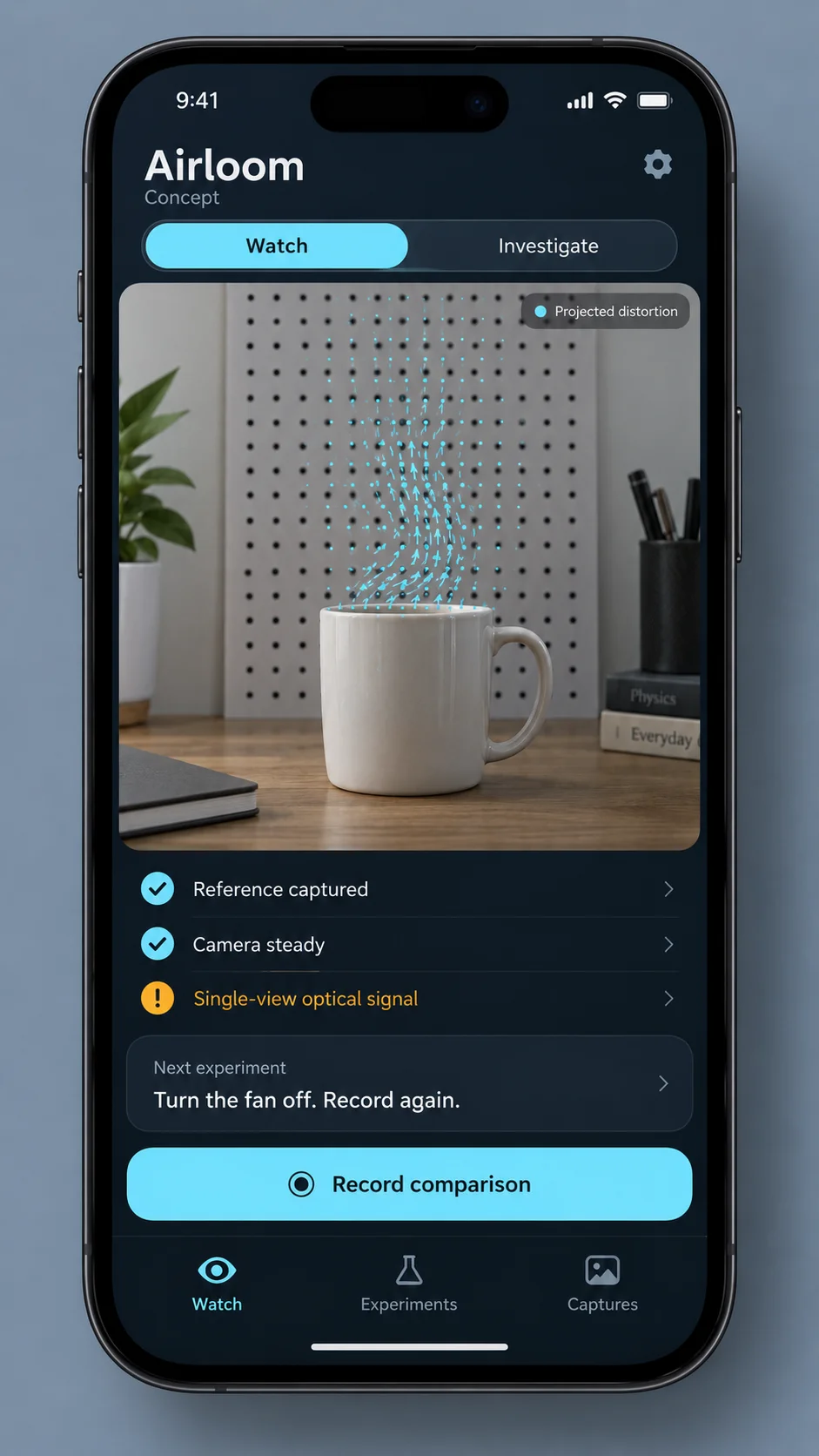
The idea
Point a phone at a controlled warm-air source and reveal tiny distortions in a patterned background. Switch from Watch to Investigate to compare how a hand, fan, or open door changes the optical signal—a miniature airflow laboratory on a desk.
How it works
- Air with varying density bends light slightly. Background-oriented schlieren tracks the resulting tiny shifts in a textured background; a 2019 study demonstrated this sensing ingredient with an iPhone 7, including moving-camera and textured-wallpaper experiments.
- Start with one steady camera watching a controlled warm-air source and printed dots behind it. A second phone can display the pattern; it contributes the measurement background rather than another camera view.
- Register reference and test footage, estimate a projected optical distortion field, and compare repeated captures as a hand, fan, or door changes the scene. The overlay must follow measured light changes rather than recognition of a mug.
- In Investigate, ask for a useful next experiment, such as keeping the camera still and recording with the fan off. The long-term goal is a manipulable flow model whose predictions can be tested physically.
- A single view supplies a projected optical measurement, not an unambiguous 3D wind field, gas identity, or direct temperature reading. Additional views, controlled repetition, or explicit assumptions are needed for richer reconstruction.
AI’s role: Maintain competing explanations for apparent flow, camera shake, focus changes, compression, and background motion, then request experiments that distinguish them. Longer offline work can optimize registration, background patterns, and candidate fluid models, but must predict held-out frames or new physical experiments.
First demonstration
Recover a repeatable distortion field above a controlled warm-air source, then show it disappearing or changing when the source changes. Repeat reference and test captures to distinguish the signal from registration error before attempting the hot-mug experience.
What to solve next
Can the system separate weak refractive changes from camera movement, focus, compression, and background motion, and predict a new airflow experiment without overclaiming what a single projected view reveals?