
The idea
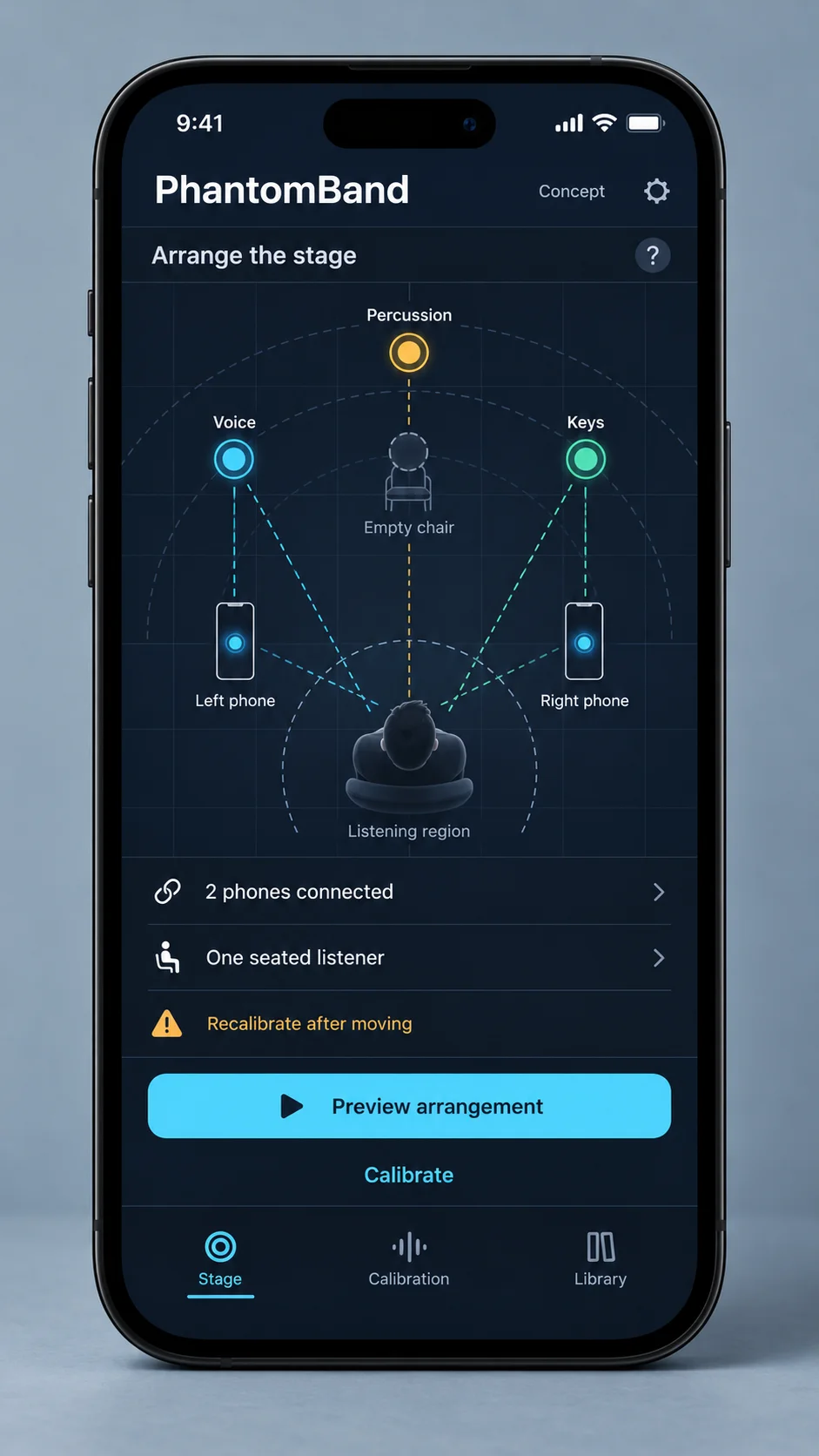
Two phones on a desk become a calibrated loudspeaker pair for one seated listener. Arrange a small performance on screen and test whether a voice or instrument seems to occupy empty space away from the physical phones, then share the arrangement.
How it works
- Binaural reproduction through loudspeakers uses crosstalk cancellation: filter each output to reduce the unwanted contribution at the opposite ear and better reproduce ear-specific signals for a virtual source.
- Place two phones to the listener’s left and right, estimate their timing and acoustic responses with microphones, and track the listener’s head with a front camera. Independently clocked phones and ordinary room reflections make calibration a central research problem.
- Include listening tests: ask where a source seems to be, which rendering feels outside the phone, and whether a small head turn breaks the effect. A room scan alone does not reveal exactly what reaches the listener’s eardrums.
- Select or interpolate position-dependent filters at runtime. Head-tracked personal sound-zone research such as SANN-PSZ is a related building block, not proof that a two-phone system delivers this proposed experience.
- Begin with one seated listener, a small listening region, and a limited set of virtual positions. This is a spatial-hearing illusion; it creates neither a physical source in an empty chair nor a sound bubble that others cannot hear.
AI’s role: Learn an acoustic model and listener-specific rendering preferences, then search offline for a family of filters robust across a small region of head positions. Test timing, speaker response, reflections, and calibration uncertainty, and stop claiming a convincing effect where the measured listening results do not support it.
First demonstration
Run a blinded listening test comparing the calibrated pair with ordinary stereo. Check whether listeners consistently perceive a source away from the physical phones, then test whether modest head movement breaks the effect.
What to solve next
Can two independently clocked phones maintain useful crosstalk cancellation despite speaker differences, room reflections, listener-specific hearing, and modest head movement?