
The idea
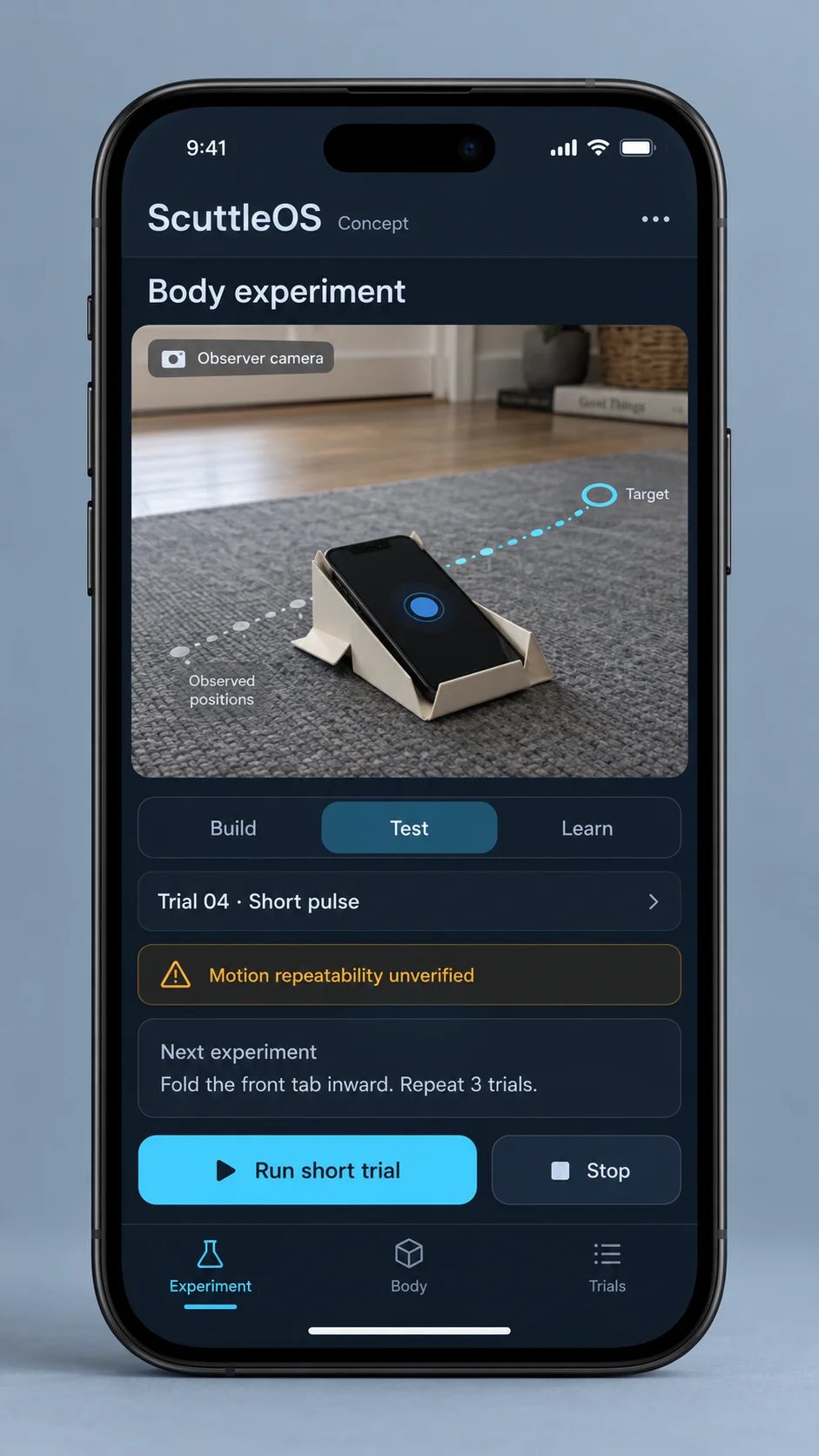
Put a phone in a low, folded cardstock cradle and let short haptic trials test whether it can learn a repeatable shuffle. A second phone measures real movement while an agent improves pulse patterns and suggests changes to the passive paper body.
How it works
- Vibration can produce net movement through asymmetric contact and friction. Research robots using a tilted vibration motor establish a relevant mechanism, but do not prove that a phone’s haptic actuator can move or steer a phone-and-cradle combination.
- Fold a low, stable cardstock cradle with asymmetric contact points, stiffness, and orientation. The passive body is part of the experiment; it adds no electronics, wheels, or motors.
- Use the real Core Haptics controls—timing, intensity, and sharpness—to run short, supervised pulse patterns. An observing phone tracks actual displacement and rotation, while the moving phone records its motion sensors.
- Build a body, measure its response, learn a model, search for useful movements, and propose a better fold. Repeat after resetting the phone and compare learned sequences with untrained ones.
- Only after repeatable translation and rotation are established should the experiment attempt a floor target. The longer-term product is a robotics laboratory with shared body templates and controllers, leading to proposed maze challenges, self-turning camera cradles, or physical games.
AI’s role: Learn which motion primitives a particular phone-and-body combination supports, repeat noisy trials, and optimize both the controller and contact geometry. Offline work can explore candidate models and select informative physical trials, including a request to fold a tab differently; AI cannot compensate for missing controllable motion.
First demonstration
Establish repeatable, distinguishable translation and rotation on one supported phone-and-cradle combination. Reset and repeat the trials, then check whether a learned sequence outperforms an untrained one before attempting target navigation.
What to solve next
Do the available haptic controls and passive contact geometry provide enough repeatable translation and rotation to learn useful behavior? Without those motion primitives, there is no controllable robot.