
Concept ratings
Author’s estimates.
The idea
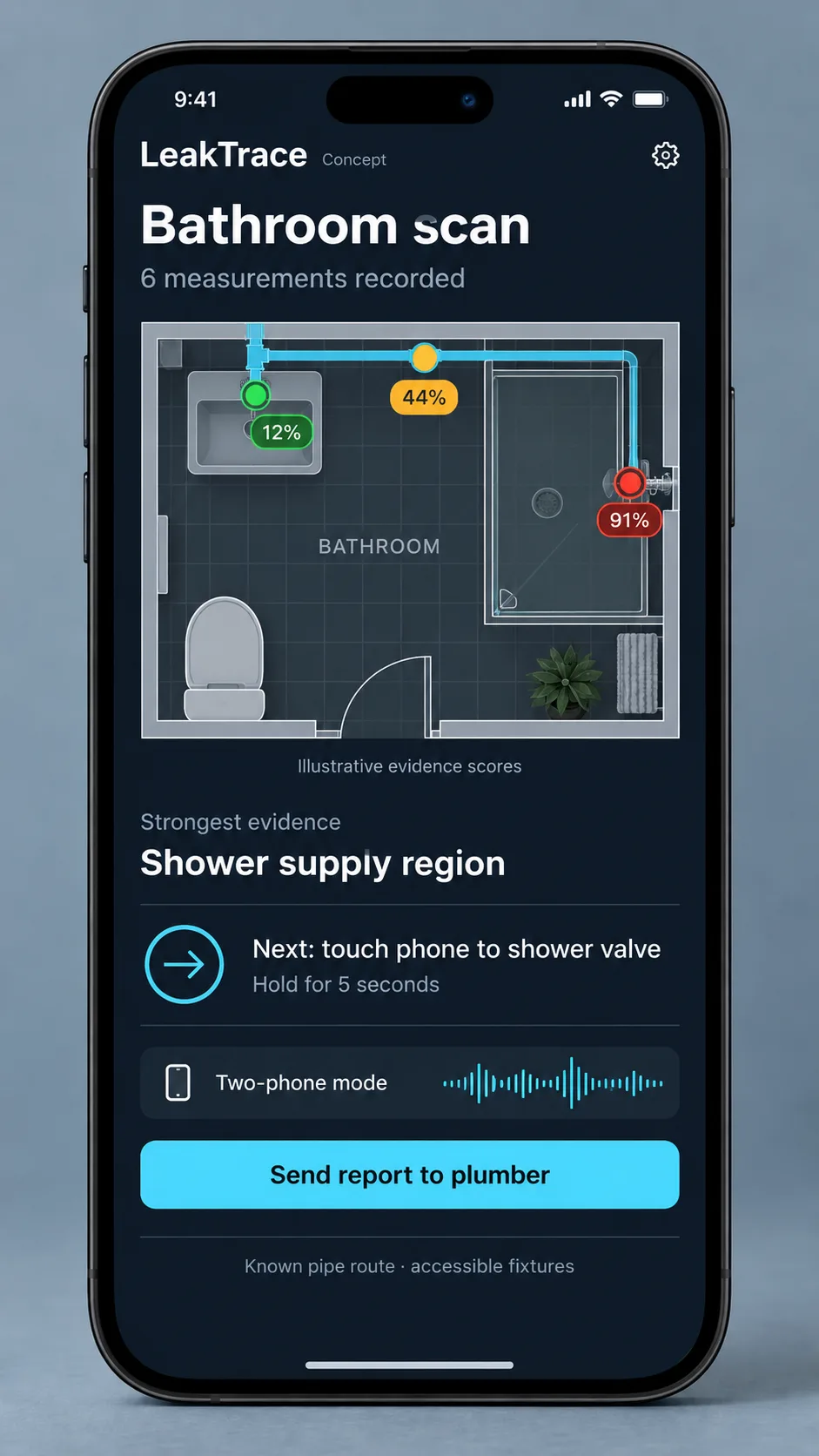
When a wet spot or a jumped water bill leaves you unsure what to tell a plumber, LeakTrace guides repeatable phone readings around accessible plumbing and builds a map of where the evidence points. It starts with fixtures and known pipe routes; locating an arbitrary leak behind an unknown wall remains an unproven research goal.
How it works
- Guide five-second contact readings first at a faucet, then at the shower valve, then at marked wall or access points. Show where and how to hold the phone so readings can be repeated under comparable conditions.
- Save timestamped vibration and acoustic recordings with the phone position and contact conditions. Build a six-measurement evidence map; example values such as 12%, 44%, and 91% are illustrative scores, not measured probabilities.
- A future distance estimate such as ‘1.8 m behind the shower valve’ is only plausible along a known pipe route with a propagation model and validated calibration. A phone alone has not been shown to locate hidden leaks at that distance.
- Test an optional two-phone capture with one phone held stationary at a pipe or access point while the other moves between marked positions. Correct clock offset and drift and register both phones to shared coordinates before comparing concurrent recordings; phone coupling, microphone bandwidth, and noise may erase any benefit.
- Use the next recommended measurement to distinguish the remaining candidate regions, with an AR arrow pointing to the marked position to test. Send a plumber a report with the floor plan, measurement locations and conditions, original audio and vibration, candidate regions, confidence, and unknowns.
AI’s role: Keep competing explanations—such as a leak near the shower valve or farther down the supply line—and choose the next reading by expected information gain. Illustrative 94%/6% scores are not calibrated evidence; measured recordings, timing, coupling, and validated pipe models must support any confidence shown.
First demonstration
Use a controlled residential plumbing rig with an exposed, known pipe route, a known leak, and healthy controls. Repeat readings with different phones and cases at documented contact points. Compare single-phone and calibrated two-phone estimates with the measured leak location and a simple loudness baseline; check whether the recommended next reading reduces uncertainty. Start with accessible residential plumbing and rank the strongest-supported region or access point, not an arbitrary point behind any wall.
Who pays
Plumbers and property-maintenance teams could pay for guided intake and reports if the evidence helps them choose what to inspect. Landlords and adjusters may also use the report to coordinate a response.
How it spreads
Plumber → five-minute scan link → customer report → next job. A landlord can send the link to a tenant, a manager to maintenance, or an adjuster to a homeowner; each report gives the recipient a useful next step and a reason to pass the scan along.
What to solve next
Can repeatable contact vibration and acoustic measurements from ordinary phones distinguish leak regions across pipe materials, phone models, cases, and fixtures? Dedicated-sensor studies provide research leads, not evidence that bare phones work. Coupling, bandwidth, plastic-pipe attenuation, wave speed, independent clock calibration, and confidence calibration all need testing.