
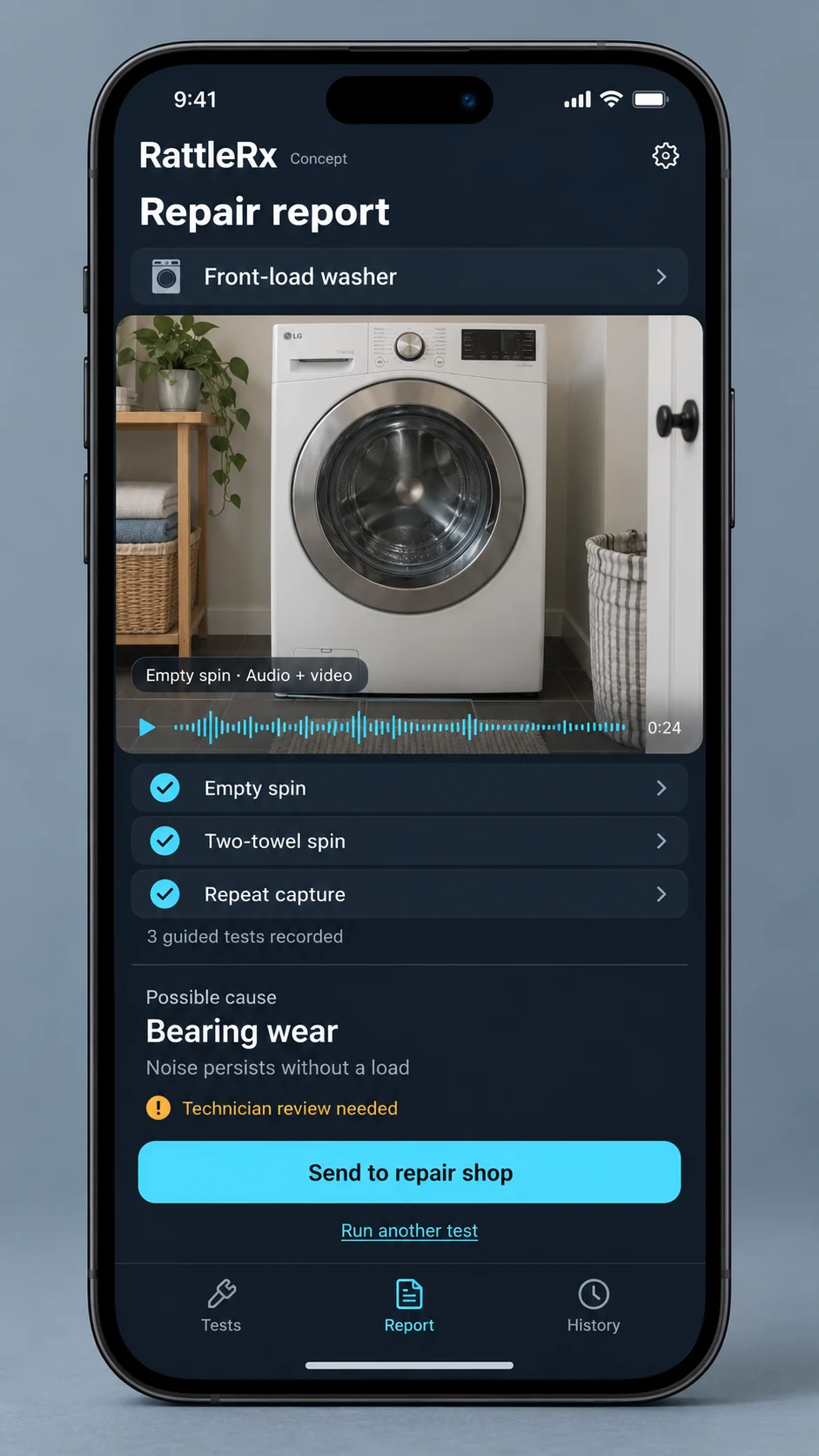
The idea
A phone guides repeatable washing-machine tests, compares sound and vibration with and without a load, and turns the evidence into a report a repair technician can review before a visit. Start with a few washer and dryer models.
How it works
- Identify the appliance model and guide a short repeatable test. Record timestamped audio, accelerometer, gyro, and available video, with phone placement documented; use separate supported capture positions when one position cannot provide useful video and contact vibration.
- Compare an empty spin, a balanced two-towel spin, and a repeat capture at comparable operating speeds. Estimate rotation rate only where the periodic signal supports it, retaining uncertainty and the original recordings.
- Compare how the signatures change under controlled conditions to rank explanations such as imbalance, bearing wear, or a loose component. Preserve an unknown result when phone coupling, sensor bandwidth, or evidence is inadequate.
- Send the repair shop a web report containing the model, test conditions, recordings, spectra, candidate explanations, and limitations. A technician can review it without installing an app, request another test, or prepare a provisional quote.
- The technician sends the same capture link to the next customer before scheduling. More useful incoming evidence gives the shop a reason to make RattleRx part of its intake process.
AI’s role: Maintain competing fault explanations and choose the next useful test, such as an empty spin or a balanced two-towel load. Signal processing extracts repeatable features; appliance-specific evidence and technician review determine whether a fault hypothesis deserves confidence.
First demonstration
On one supported washer model, repeat healthy empty and balanced-load captures, then compare them with consented recordings from technician-confirmed faults. Hold out entire machines when evaluating the classifier, and ask technicians whether the reports improve triage over an ordinary phone recording.
Who pays
Independent appliance-repair shops pay for guided intake and report review if it reduces unproductive visits or helps them prepare. Customers open the shop’s capture link and send the evidence back.
How it spreads
Customer → repair report → technician → capture links for the next customers. The recipient gets a useful web report first, and a reason to request another capture.
What to solve next
Can useful signatures survive different phones, cases, floors, recording positions, and appliance speeds? Smartphone rotating-machine research supports the sensing direction, but does not establish washing-machine accuracy or calibrated fault probabilities.