
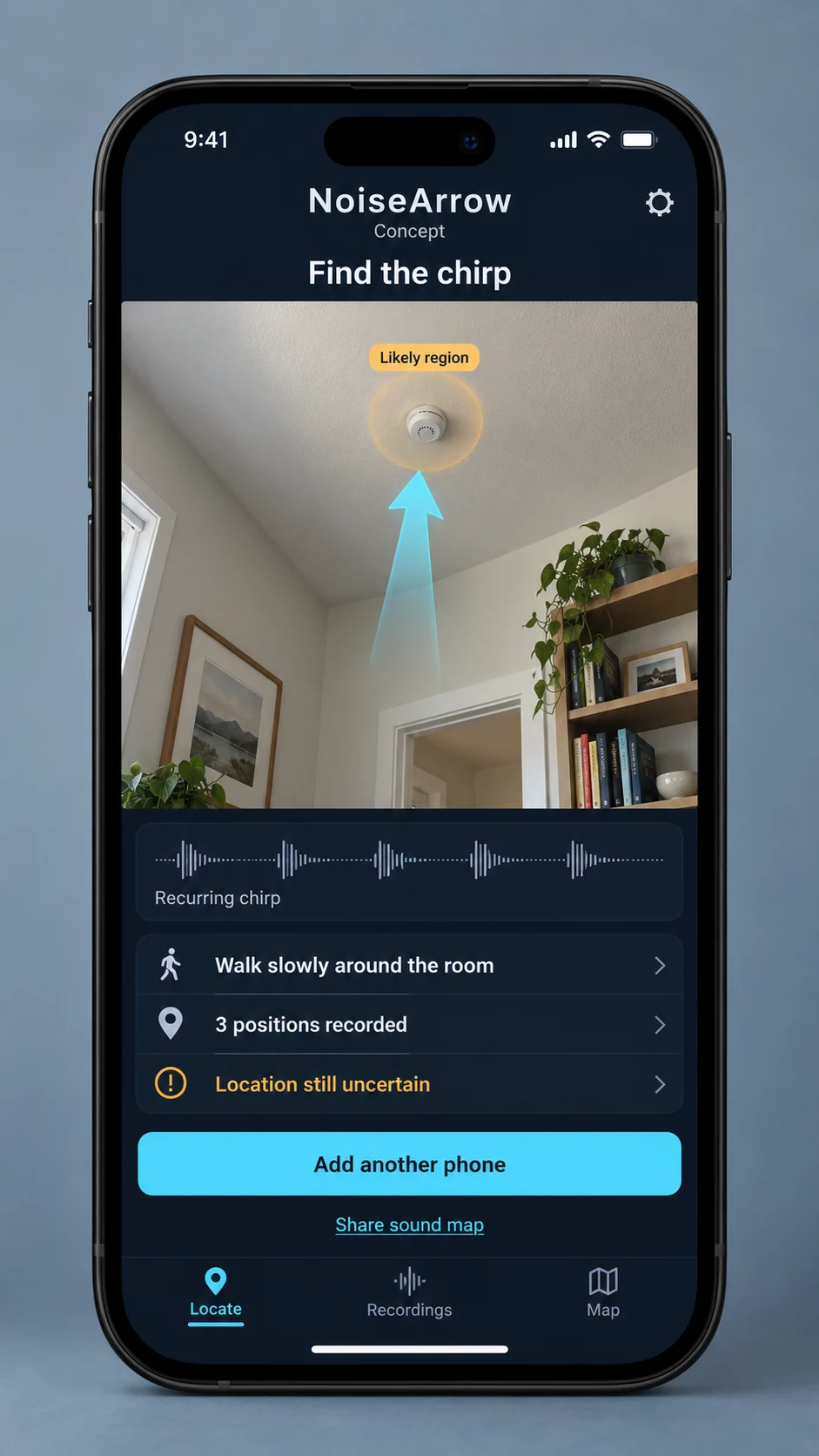
The idea
Walk slowly around a room while a phone records a recurring sound and tracks its camera pose. NoiseArrow tests which source region best explains the observations, points toward that region in AR, and lets another person join with a second phone.
How it works
- Choose an isolated recurring sound, such as a low-battery detector chirp, and walk slowly between recording positions. Capture audio alongside timestamped camera poses in one tracked room map.
- Match comparable sound events and compare acoustic observations across positions. Account for microphone orientation, automatic gain, changing source volume, pose drift, and room reflections rather than treating loudness alone as distance.
- Fit candidate source locations and show an approximate region with uncertainty. A moving phone does not automatically become a phase-coherent microphone array; irregular chirps may provide too little evidence for a useful location.
- Guide a new measurement where it could distinguish the remaining regions. The first visual target is an AR arrow narrowing toward a ceiling detector, without promising centimeter accuracy.
- Send a join link so another person can contribute a second phone. Establish a shared spatial map and estimate clock offsets before combining observations; share the resulting map and recordings with maintenance.
AI’s role: Identify repeated instances of the target sound, reject unrelated events, and suggest the next informative recording position. Acoustic estimation and measured poses constrain the source region; AI recognition alone cannot establish its location.
First demonstration
Place one recurring chirp source at a measured position in a quiet room. Compare the estimated region against its true location across several walking paths, then test whether a calibrated second phone improves the result. Repeat with reflections and a competing sound before claiming general room localization.
Who pays
Property-maintenance teams could pay for shared recordings and sound maps across jobs. The consumer entry point is a single understandable task: find an intermittent chirp or buzz.
How it spreads
Person with a mystery noise → invite another phone → shared sound map → landlord or maintenance worker. The helper has an immediate reason to join, and maintenance can reuse the capture link on another job.
What to solve next
Can ordinary phone microphones and repeated sound events constrain a useful region in a reverberant room? Related SLAM localization research used mobile microphone arrays, which provide richer directional measurements than a lone phone.