
The idea
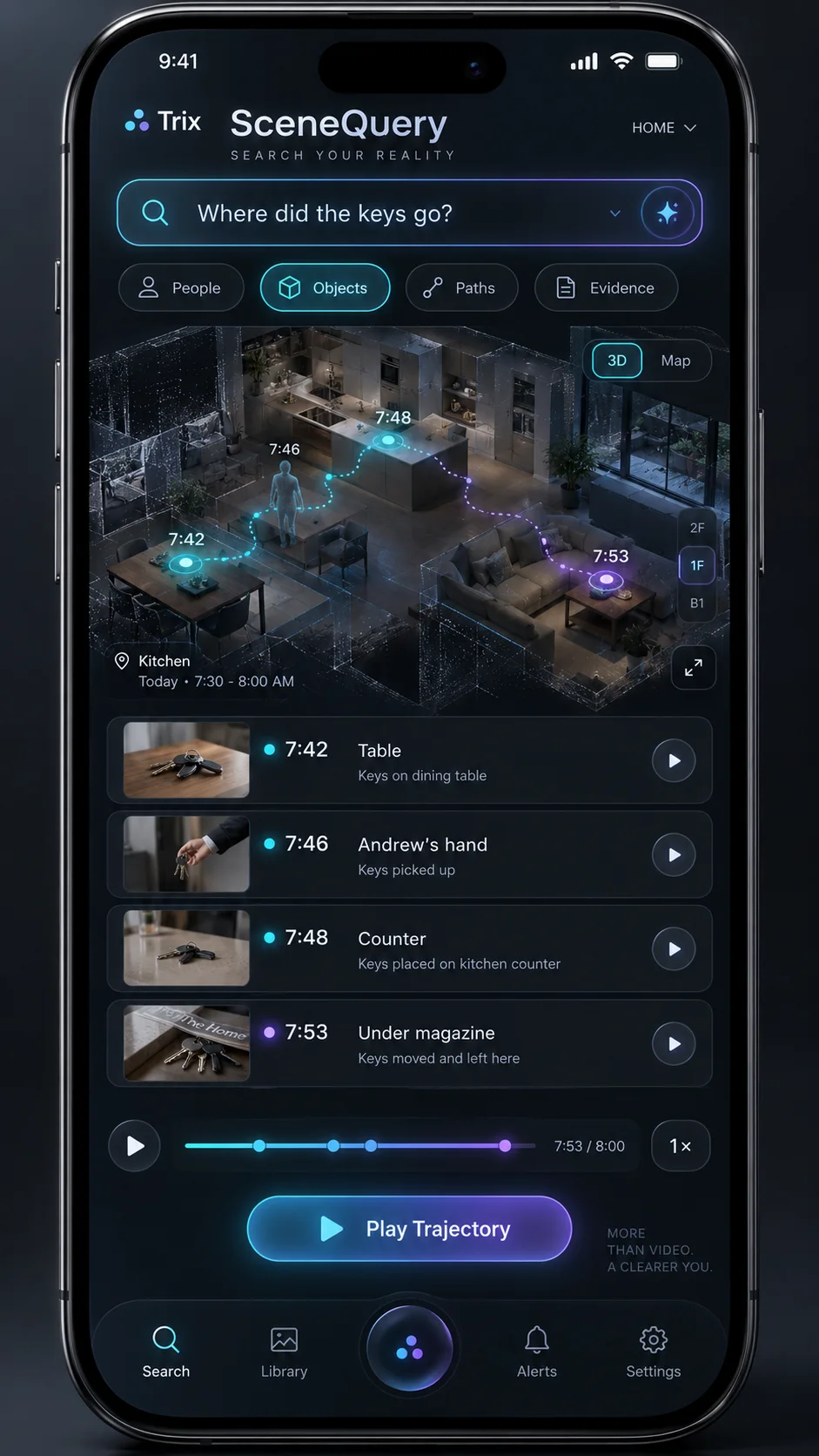
Multi-phone capture builds a searchable record of people, objects, locations, audio, time, geometry, and observations. Ask where the keys went, who moved a chair, or every time someone touched a ball, then inspect the camera evidence.
How it works
- Several phones capture overlapping views and build a structured event with people, objects, places, audio, time, geometry, and observations.
- Track objects and people across cameras and time, retaining the views and intervals that support each observation.
- Answer natural-language questions with timestamped trajectories and clickable camera evidence, leaving gaps explicit when the recording cannot support an answer.
AI’s role: Plan language queries over tracked observations and explain uncertainty; synchronization, reconstruction, re-identification, and scene understanding must supply timestamped evidence for answers.
First demonstration
Place four phones around a table and record three people moving a red cup, blue cup, and keys for 60 seconds. Query for the keys and show the supported path—table, Andrew’s hand, counter, under a magazine—with evidence at each stop and a Play Trajectory control.
What to solve next
How reliably can the system preserve identity through occlusion, synchronize observations, and answer with evidence while exposing uncertain or missing intervals?