
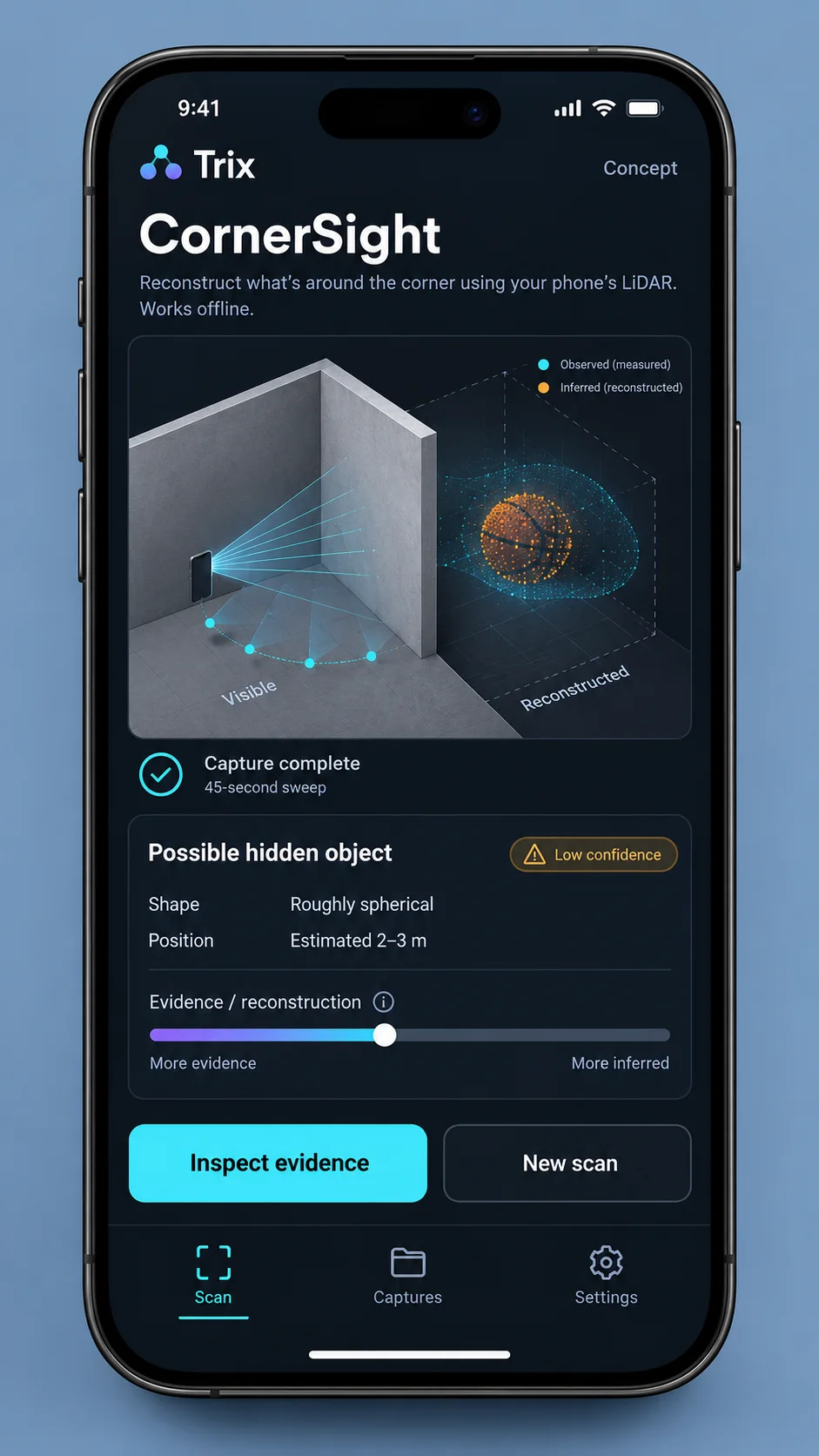
The idea
Slowly sweep an iPhone near a wall and collect weak indirect LiDAR observations from many tracked positions. An offline solver tests hidden-scene models against the measured returns and may estimate an object's location or motion, with uncertainty; processing may take hours.
How it works
- Sweep one iPhone slowly for 30–60 seconds while recording synchronized reusable capture.trix evidence, including available depth, camera pose, motion, and timing and calibration metadata.
- An offline inverse solver simulates indirect returns for candidate hidden geometry, object, or motion models, then compares predictions with measured residuals; a run may take hours.
- The result may be an approximate hidden-object location or blurry reconstruction with an uncertainty region, not a guaranteed view around a corner.
AI’s role: Suggest candidate hidden-scene models and explain the uncertainty; inverse rendering and residual comparison must be grounded in exposed sensor measurements and calibrated poses.
First demonstration
Place a basketball behind a cardboard wall and make a 45-second LiDAR sweep with one iPhone. Test whether the offline solve favors a spherical-object hypothesis and produces an uncertainty blob near the ball's measured position.
What to solve next
Do iPhone APIs expose the raw LiDAR measurements this method needs, and how sensitive is a result to pose drift, multipath, surface reflectance, and weak indirect returns?